In my Monday Seasons Art Class we learned to use a pallet knife with acrylic paint.
In the first assignment we were instructed to use any colours to explore different pallet knives and what marks you can make. It was only an exercise but it yielded pretty nice results.
For the second assignment we were to use only a pallet knife to paint a shell or sea creature, thinking the sea horse would be easy, that’s what I did. It was difficult to draw something specific with the knife so really not a fan.
For the final assignment we were to create any abstract we wanted, so similar to the first assignment this red, white and blue abstract was born.
It’s strange because I started taking art classes to train to draw and paint more realistic looking things and what I really like to do is create abstract art. Abstract may be my style, but I’m going to take a drawing class next term to be sure.
Watercolour classes with Karen Pearson were a good opportunity to learn drawing and composition but my watercolour skills didn’t really advance.
To my surprise, in only one of Karen's acrylic painting classes I felt a big improvement. At home, there were a few minor adjustments but for the most part the painting was finished in 3 hours. As always there are things that probably could be perfected but I want to paint something new in her next class.
Project 35 in “Little Ways to Learn Acrylics: 50 small painting projects...” by Mark Daniel Nelson is ‘Rendering a transparent object: Balloon dog’. This exercise is now my favourite; from the first step the image was pretty remarkable. My only regret is that I painted it on mixed media canvas and not a canvas board. The book suggests trying this exercise again with different balloon animals and colours… will do it after finishing the book :).
The final 16 projects in “Little Ways to Learn Acrylics: 50 small painting projects...” by Mark Daniel Nelson is Chapter 4, ‘rendering surface and form'.
 Project 34 ‘Painting simple highlights: Light bulb’ was an example in rendering focus on glass and metal. In my opinion, the painting was uninspiring but the lesson was a good one.
 In one of Wendy’s classes we painted a white duck in watercolour; I painted the same duck Wendy demonstrated. Watercolour is still a difficult medium for me to use, so it was easier to follow by instruction. Even though much more time was spent on it, mine didn’t come out half as nice as the tutor’s or the original.
 The next week we were to select an image of a white bird to paint in acrylics. Painting in acrylics is much easier and I drew an image from Paint My Photo. I was happy with the final painting and even signed it :).
These two projects are the last in Chapter 3 - 'beyond the basics'. Can't believe it, but my first painting in “Little Ways to Learn Acrylics: 50 small painting projects...” by Mark Daniel Nelson was back in November.
Looking forward to moving onto Chapter 4 and probably for the first time in a long time finishing what I started.
Project number 32 ‘Accenting with a complementary colour: Birch trees’ came out better than I thought it would. At first, the steps to finishing the painting seemed odd but the final result was pretty nice and despite my prejudice...I liked it.
Project number 33 ‘Using exaggerated colour: Expressionist landscape’ was all about various colours as well as shapes; in my opinion it didn’t look so great. Probably should have tried to do my own thing and make some alterations to the instructions, but really I’m just ready to move on to the next chapter.
Project 31 in "Little Ways to Learn Acrylics: 50 small painting projects..." by Mark Daniel Nelson was 'Creating contrast with temperature: Sunflowers’. I’m not experienced with painting sunflowers but all in all they came out pretty nice. I probably should have stopped sooner because with too many layers of yellow, the flowers don’t pop as much as they did. I prefer the poppy painting.
Project 30 in "Little Ways to Learn Acrylics: 50 small painting projects..." by Mark Daniel Nelson was ‘Massing multiple objects: Poppy field’. As mentioned before, I don’t like massing or painting from loose paintings; but I do like poppies. This project started out looking good, then there was a moment where it went all wrong. After working on it for a day or two I was able to salvage the painting to a point where I really liked it. This method was difficult but effective and the poppies look vibrant.
Project 29 in ‘Little Ways to Learn Acrylics: 50 small painting projects...' by Mark Daniel Nelson was ‘Massing in nature: River and trees’. Sorry to say but I didn’t like this exercise either (see Project 28; Bananas); not a big fan of massing. This whole chapter is really challenging for me; loose painting from images that are loosely painted is a real nuisance. I worked on this landscape over several days until it looked presentable enough to publish.
Couldn’t wait to start Chapter 3 but now I can’t wait to finish it:(
Project 28 in ‘Little Ways to Learn Acrylics: 50 small painting projects..." by Mark Daniel Nelson was ‘Massing shapes: Bunch of bananas’. The technique called ‘massing’ involves combining groups of small detailed shapes into larger more generalized shapes. Well I didn’t like it; for me, it’s easier to work from a more specific outline.
My first try came out really awful so then I painted a bunch of bananas that were in my kitchen. After getting a feel for what bananas looked like, I went back to trying the project from the book. In the end I was satisfied with the final product.
I’m posting two projects from ‘Little Ways to Learn Acrylics: 50 small painting projects..." by Mark Daniel Nelson today. One is a city scene the other a snow scene, both on 8" x 8" mixed media paper.
 Project number 26 ‘Large shapes and small details: City scene’ is a pleasant abstract landscape. The approach to ‘loosely represent the larger shapes in the scene and add a few well-placed details’ seems simple; but in my opinion... it’s not. My painting looked alright, however if the steps weren't mapped out for me, it might not have.
Project number 27 ‘Simplifying a landscape: Snow scene’ in my eyes isn’t a great painting. By not taking it too seriously the results were better than expected. The example in the book had too much blue so I used a lighter shade to make the snow more realistic.
Project 25 in ‘Little Ways to Learn Acrylics: 50 small painting projects..." by Mark Daniel Nelson was ‘Painting with coloured shapes: Rooster’. The idea was to paint ‘subjects with soft edges and gradated colours’ and the book indicated that it’s ‘more difficult to paint in acrylics than images with distinct, hard-edged shapes’. It was difficult for me as well, primarily because I was working from a painting and not a photo or real subject.
This project is now at the half way point; only eight more paintings till Chapter 4. It looks like all the paintings till the end of Chapter 3 will be difficult as well. A free style mark making technique is hard to duplicate exactly as the original. Only having the finished painting and not the original image makes it tough to interpret what the artist has in mind… even with instructions.
Project 24 in ‘Little Ways to Learn Acrylics: 50 small painting projects..." by Mark Daniel Nelson was ‘Redefining the brushstroke: Drip Painting’. Jackson Pollock is one of my favourite artists so there was no trouble making this painting. The only thing is knowing when to stop. I took a few photos of the different layers just for fun.
Moving right along; I’ve posted two landscape projects from ‘Little Ways to Learn Acrylics: 50 small painting projects..." by Mark Daniel Nelson.
 Project number 22 ‘Varying brushstrokes: Road and sky’ came out nicer than expected. Most of the landscape projects in this book haven’t really been my thing. For some reason I liked this one; it’s loose, was easy to create and the image is easy on the eye.
 Project number 23 ‘Using loose strokes: Impressionist landscape’ didn’t come out as well as the previous one. The technique was similar but the colours were more vibrant. This painting was hard for me because I was working from the artists painting and not from my own image. I like the technique but would like to try it on one of my own landscape photos.
Project 21 in ‘Little Ways to Learn Acrylics: 50 small painting projects..." by Mark Daniel Nelson was ‘Using expressive strokes: Flowers in a glass’. The instructions for this exercise were to create simple shapes for the flowers by scribbling or hatching.
Because I don’t like to see white on the canvas, my first version had a light purple background.
The purple background didn’t allow the flowers to look as vivid, so I prepared a second painting with a white background. This painting was done very quickly and the flowers were brighter; but I think the first one is better… possibly because it’s tidier.
The second painting, project no 20 from Chapter 3 in ‘Little Ways to Learn Acrylics: 50 small painting projects..." by Mark Daniel Nelson was ‘Using hatching strokes: Bird’s nest’. The assignment was to use directional brush strokes to create the illusion of form. It was very similar to project no 19 and also harder to create than it looked. After spending way too much time on the bird's nest, I decided to stop over working it. Again the example in the book was nicer than my painting... hope this doesn't become a trend.
After much anticipation it’s time to start Chapter 3 in "Little Ways to Learn Acrylics: 50 small painting projects..." by Mark Daniel Nelson. This chapter is less about acrylic painting fundamentals and more about design principles and brushstroke techniques.
Project number 19 ‘Using contour strokes: Ball of wool’ is all about how the stroke direction can make the object look three-dimensional. This wasn't as easy to accomplish as it might seem. In hindsight, the top of the ball would probably look better if it was a little lighter; for this exercise the painting in the book was nicer.
This landscape exercise in ‘Vibrant Acrylics’ by Hashim Akib was the most difficult for me to date. The colours and composition in Hashim’s painting were somehow difficult for me to apply. This painting was on my easel for over a month and although I reworked sections, I was still not happy with it.
In a moment of clarity or craziness, I decided to try a smaller version on acrylic paper. Disappointed with the brushwork again... I took out my pallet knife and created something prettier than my first version. Can’t wait to start the next painting in the book and hope I have better success.
Assignment number 3 in “Abstracts 50 Inspirational Projects” by Rolina van Vliet turned out really nice, even though my painting is a slight deviation from the monochrome colour requirements specified in the book.
 To make starting the project easier, I followed the examples in the book and used red with gold outlines. After that, my own colours and marks were used. I had fun with a new tube of Pebeo relief outliner paint and may have gone a little design crazy, but I'm happy with the results. After all it’s my abstract... the book just gave me inspiration.
This study involved working from a figure sketch and drawing it abstractly in ink; even though I took a life drawing class this wasn’t easy. It also required sand, which I couldn’t find, so I used a sand & modelling paste mixture.
 My first attempt didn’t look right because the ink figures weren’t anatomically correct so I started again. The second time wasn’t really successful either, so I cropped the painting and have posted it even though it's not perfect. I enjoyed using the sand mixture and liked the way ink worked with wet paint, but my figures looked funny. It's difficult to get an accurate body shape that is also abstract.
 Rolina van Vliet has done it to perfection in her example on pages 52 & 53 of “Abstracts 50 Inspirational Projects”. This is a method I would really like to explore more.


 Project 34 ‘Painting simple highlights: Light bulb’ was an example in rendering focus on glass and metal. In my opinion, the painting was uninspiring but the lesson was a good one.
 In one of Wendy’s classes we painted a white duck in watercolour; I painted the same duck Wendy demonstrated. Watercolour is still a difficult medium for me to use, so it was easier to follow by instruction. Even though much more time was spent on it, mine didn’t come out half as nice as the tutor’s or the original.
 The next week we were to select an image of a white bird to paint in acrylics. Painting in acrylics is much easier and I drew an image from Paint My Photo. I was happy with the final painting and even signed it :).

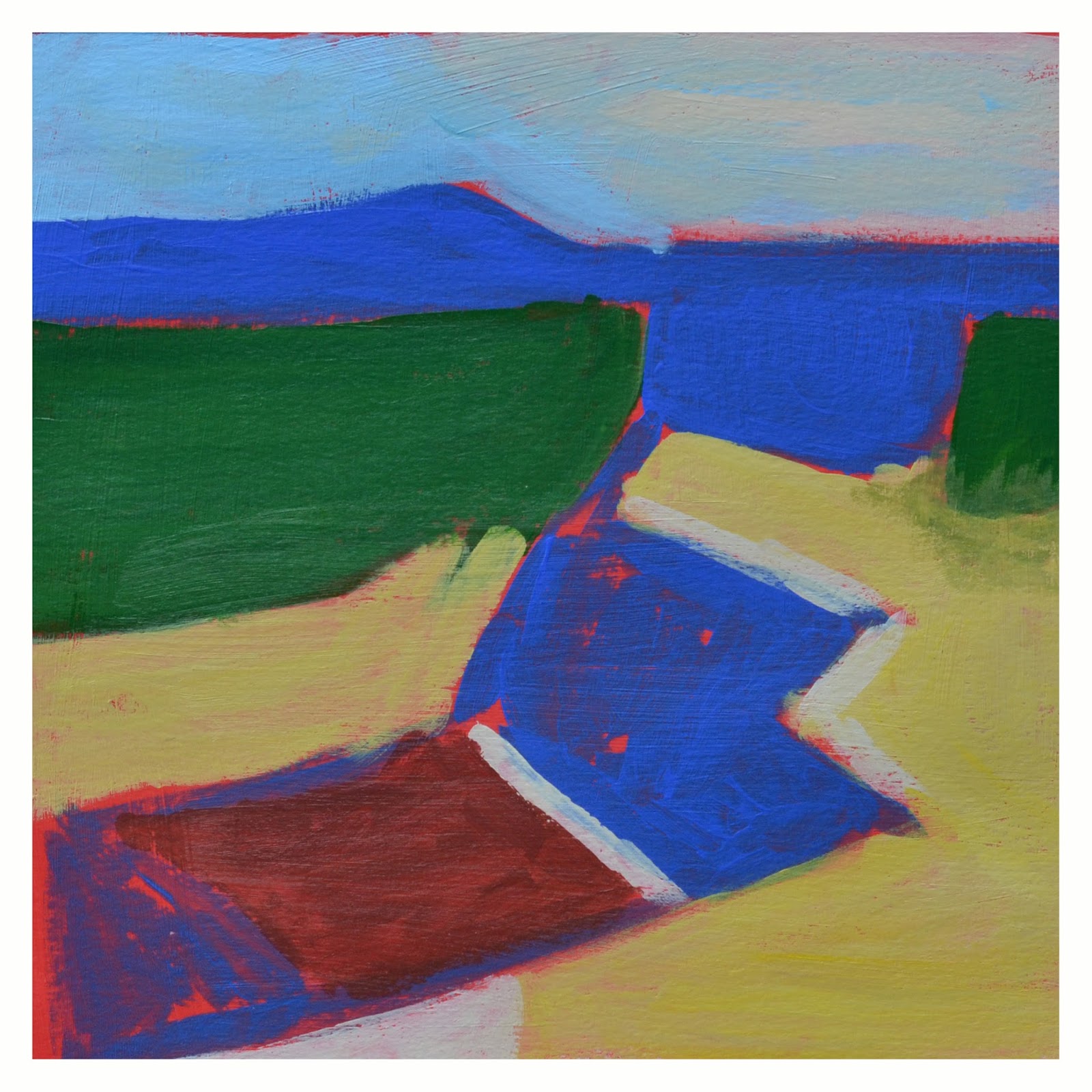


 Project number 26 ‘Large shapes and small details: City scene’ is a pleasant abstract landscape. The approach to ‘loosely represent the larger shapes in the scene and add a few well-placed details’ seems simple; but in my opinion... it’s not. My painting looked alright, however if the steps weren't mapped out for me, it might not have.


 Project number 22 ‘Varying brushstrokes: Road and sky’ came out nicer than expected. Most of the landscape projects in this book haven’t really been my thing. For some reason I liked this one; it’s loose, was easy to create and the image is easy on the eye.
 Project number 23 ‘Using loose strokes: Impressionist landscape’ didn’t come out as well as the previous one. The technique was similar but the colours were more vibrant. This painting was hard for me because I was working from the artists painting and not from my own image. I like the technique but would like to try it on one of my own landscape photos.


 To make starting the project easier, I followed the examples in the book and used red with gold outlines. After that, my own colours and marks were used. I had fun with a new tube of Pebeo relief outliner paint and may have gone a little design crazy, but I'm happy with the results. After all it’s my abstract... the book just gave me inspiration.
 My first attempt didn’t look right because the ink figures weren’t anatomically correct so I started again. The second time wasn’t really successful either, so I cropped the painting and have posted it even though it's not perfect. I enjoyed using the sand mixture and liked the way ink worked with wet paint, but my figures looked funny. It's difficult to get an accurate body shape that is also abstract.
 Rolina van Vliet has done it to perfection in her example on pages 52 & 53 of “Abstracts 50 Inspirational Projects”. This is a method I would really like to explore more.
